Wednesday, 27 April 2016

IX--CLASS--PHYSICS WORKSHEET 2

ARMY PUBLIC SCHOOL, GOLCONDA
Class 9 – Physics - Ch 8 – Motion
(WORKSHEET - 2)
Subtopic –
·       UNIFORM & NON-UNIFORM MOTION.
·       Graphical representation of DISTANCE-TIME


Fill in the blanks

1. The motion of the earth around the sun is ___________ (uniform /non-uniform).

2. When a stone falls from a height, its motion is ___________ (uniform /non-uniform).


3. A car travels 10 km in every 5 minutes; its motion is ___________ (uniform /non-uniform).

4. In ___________ (uniform /non-uniform) motion, object travels with uniform speed/velocity.


5. In the story of hare-tortoise, motion followed by rabbit is ___________ (uniform /non-uniform).

6. In ___________ (uniform /non-uniform) motion, object travels with variable speed/velocity.


7. In uniform motion, distance.-time graph is a ___________ (straight /curved) line.

8. In non-uniform motion, distance.-time graph is a ___________ (straight /curved) line.

9. In uniform motion, slope of distance.-time graph is nothing but ___________ (speed /distance).

10. In distance.-time graph time is represented on ___________ (horizontal /vertical) axis and distance is represented on ___________ (horizontal /vertical) axis.

MCQs
1.  If the time-displacement graph of a particle is along X-axis, the velocity of particle is-

(a) unit value                                                                                 (b) zero
                 (c) infinite                                                                                      (d) none of these.


2.  Which of the Following time-displacement graph does not present a real situation-
(a)                       (c) 


 (b) 
                     (d)


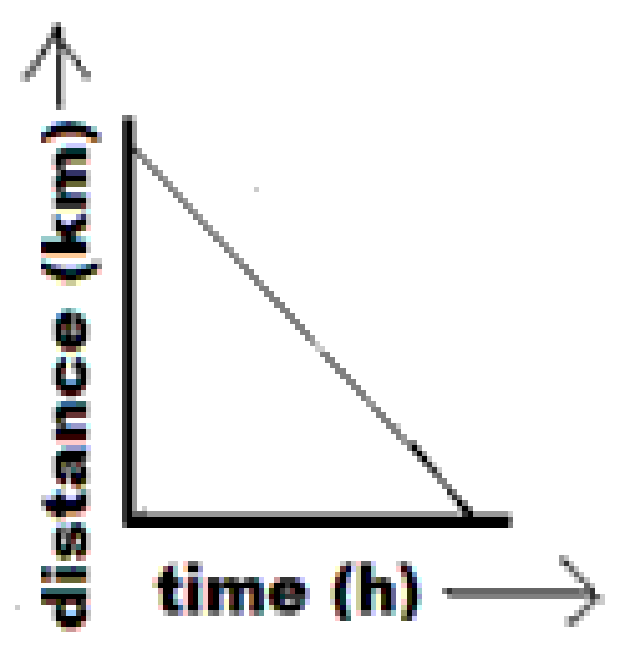
3.  The given time-displacement graph shows that body is at-

                   (a) rest                                                                                 (b) non-uniform motio
                   (c) uniform motion                                                           (d) none of these

4.  In the given time-displacement graph the distance covered by body B in 2 seconds-
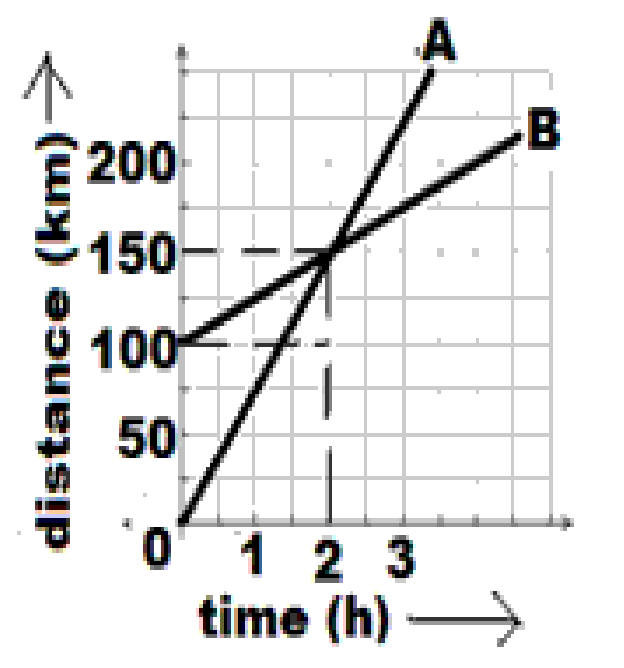
(a) 100                                                                                     (b) 200
(c) 50                                                                                       (d) 150


5.  In the given time-displacement graph the distance covered by body A in 2 seconds-

(a) 100                                                                                     (b) 200
(c) 50                                                                                       (d) 150


Q & A’s
1.  Define uniform motion with example.
2.  Define non-uniform motion with example.
3. Distinguish between uniform and non-uniform motion.
4. What are the uses of graphical study of motion?
5. What is the nature of the distance-time graph for uniform and non-uniform motion of an object?
6. What can you say about the motion of an object whose distance-time graph is a straight line parallel to the time axis?
7. Show that the distance-time graph gives speed/ velocity of the body.
(Hint: find slope).
8. What does the path of an object look like on distance-time graph when it is in-

·         Uniform motion
·         Non-uniform motion
·         Rest or a stationary body

9.  The following tables give data about motion of an automobile

TIME (seconds)
9.00
9.30
10.00
10.30
11.00
11.30
DISTANCE
( meter)
0
30
30
45
60
100


·         Plot the distance-time graph
·         Is the automobile’s motion is an example of uniform or non-uniform motion?


10.         Plot distance-time graph of the given data. And calculate speed for each case.

A)    
Time (s)
0
1
2
3
4
5
6
Distance(m)
0
10
20
30
40
50
60


B)  
Time (s)
0
1
2
3
4
5
6
Distance(m)
0
8
16
24
32
40
48
        

11.         The following data gives the displacement of body at various instant of time.
  
Time (s)
0
1
2
3
4
5
6
Distance(m)
2
4
6
8
10
12
14
        
·         Calculate velocity.
·         Calculate distance travelled in first 4 seconds?
·         Calculate distance travelled in last 4 seconds?

12.         If the body is at rest then the path followed by it on distance-time graph will be given by which line (A or B)? Why is it so, explain.

13.         Name two quantities, the slope of whose graphs gives “speed”. Show graph as well.
14.         The distance-time graph of two trains is given here. The train starts simultaneously in the same direction.
·   How much ahead of A is B when the motion starts?
·   What is speed of A and B?
·   When and where A will catch B?
·   Is the motion of both trains – uniform or non-uniform? Justify your answer.


15.         The given figure gives the distance-time graph of three objects A, B and C. Study the graph and answers the following questions.
·   Which of the three is travelling the fastest
·   Are all three ever at the same point on the road?
·   How far has C travelled when B passes A?
·   How far has B travelled by the time it passes C?


IX--CLASS--PHYSICS WORKSHEET 3

ARMY PUBLIC SCHOOL, GOLCONDA
Class 9 – Physics - Ch 8 – Motion
(WORKSHEET - 3)
Subtopic –
·       RATE OF MOTION—SPEED & VELOCITY
·       AVERAGE SPEED & AVERAGE VELOCITY.


MCQs
1.  Which of the following statements is correct?

(a)
both speed and velocity are same
(b)
speed is a scalar and velocity is a vector
(c)
speed is a vector and velocity is scalar
(d) none of these.

2.  When a body moves uniformly along the circle, then:-

(a) its velocity changes but speed remains the same
(b) its speed changes but velocity remains the same
(c)both speed and velocity changes
(d) both speed and velocity remains same

3.  Which of the following statements is correct?

(a)speed distance are scalar, velocity and displacement are vector
(b) speed distance are vector, velocity and displacement are vector
(c) speed and velocity are scalar, distance and velocity are vector
(d) speed and velocity are vector, distance and displacement are scalar

4.  Which of the following unit is incorrect-

(a)  m/s
(b)  Km/h
(c)  Km/s
(d)  none

5.  m/s is S.I. unit of-

(a)  speed                                                        (c) acceleration
(b)  distance                                                    (d) time
6.  speed of a moving body can be-

(a) can be positive
(b) can be zero
(c) can be negative
(d) all are true.

7.  velocity of a body can be-

(a) can be positive
(b) can be zero
(c) can be negative
(d) all are true.

8.  Speed = velocity + time

(a)  True
(b)  false
(c)  both (a) and (b)
(d)  Neither (a) nor (b).

9.  Velocity = Speed + time

(a)  True
(b)  false
(c)  both (a) and (b)
(d)  neither (a) nor (b).

10.     m/s is S.I. unit of-

          (a) speed
          (b) velocity
(c)  none of above
(d)  Both of above.


Q & A’s
1.  Define Speed and average Speed.

2.  Define Velocity and average Velocity.

3. Distinguish between Speed and Velocity.

4. Can a body have constant speed but varying velocity? Explain.

5. Under what conditions the magnitude of velocity (average velocity) of an object equal to its speed (average speed)?

6. Can a body have constant velocity but varying speed? Explain.

7. Can a body have constant velocity along with constant speed? Explain.

8. Is it true that in straight line, an object with zero speed may have non-zero velocity? Explain.

9. What quantity is being measured by speedometer of your automobile?

10.   Is it true that a body can have some speed but zero velocity?


Solve the following (short problems)

1.  An object cover a distance of 8 km in 2 minutes. Calculate the speed in:
(a)  m/s
(b) Km/h.

2.  Object A travelled a distance of 80 km in 4 hours and Object B travelled a distance of 100 km in 10 hours. Which object traveled faster?

3.  Arrange the following speeds in increasing order-
(a) Car moving with speed of 72 km/h
(b)  A kite moving with speed of 10 m/s
(c)  A train moving with speed of 1200 m/min

4.  What is the displacement travelled by a car if it takes 30 minutes for a journey with velocity 20 m/s.

5.  If a man walks at a speed of 2 km/h and walk a distance of 200 meters. How much time he will take to complete his walk?

6.  A car goes from A to B and covers a distance of 40 m and take 30 seconds while coming back from B to A car takes 40 seconds. Calculate average speed and average velocity for
(a)  A to B
(b)  B to A
(c)  A to A.
7.  During an experiment , a signal from a spaceship reached the ground station if 5 minutes. What was the distance of the spaceship from the ground station? The signal travels at the speed of light, that is, 3 x 10⁸ m/s.

8.  A train travels a distance of 1384 km. Train starts at 4.00 am and reach at 9.00 pm, the same day. What is the speed of the train?

9.  Sound waves travels with a speed of 3 x 10⁸ m/s. sound is audible till how far if it occurs only for 8 min 20 seconds.

10.    A 100 meter long train crosses a 300 m long bridge at a speed of 40 m/s. how much time will it take to cross the bridge completely?

11.   A car travels at a speed of 40km/hr for two hour and then at 60km/hr for three hours. What is the average speed of the car during the entire journey?

12.   A car moves through 20 km at a speed of 40 km/h, and the next 20 km at a speed of 60 km/h. calculate its average speed.

13.   A bus takes 8 hours to cover a distance of 320 km. What is the average speed of the bus?

14.   A cheetah is the fastest land animal and it can achieve a peak speed of 100 km per hour. If the cheetah spots his prey at a distance of 100 meters what is the minimum time it will take to get its prey? 

15.   An object moves through 10 m in 2 minutes and next 10 m in 3 minutes. Calculate its average speed.

Solve the following (long problems)
1.  Joseph jogs from one end A to the other end B of a straight 300 m road in 2 minutes 30 seconds and then turns back and jogs 100 m backs to point C in another 1 minute. What are joseph average speeds and velocities in jogging
(a) From A to B
(b)  From A to C.

2.   Abdul, while driving to school, computes the average speed for his trip to be 20 km/h. on his return trip along the same route, there is less traffic and the average speed is 30 km/h. what is the average speed for abdul’s trip?

3.  In the hare-tortoise race, the hare ran for 2 min at a speed of 7.5 km/h, slept for 56 min and again ran for 2 min at a speed of 7.5 km/h. Find the average speed of the hare in the race.

4.  A ship moves due east at 12 km/h for 1 hr and turns exactly towards south to move for an hour at 5 km/h. calculate the average speed and average velocity.

5.  A car travels along a straight line with speed 40 km/h from A to B and returns back B to A with speed 60 km/h. find the average speed of the car and its average velocity.

6.  A car travels along a straight line for first half distance with speed 40 km/h and the second half distance with the speed of 60 km/h. find the average speed of the car.


7.  A 40 meter long train crosses a 200 m long bridge at a speed of 36 m/s. how much time will it take to cross the bridge completely?

8.  A bus travels the first third of a distance at a speed of 10 km/h, the second third at a speed of 20 km/h and the last third at a speed of 60 km/h. determine the average speed of the bus for the entire distance.

9.  A body is moving with a velocity of 10 m/s. if the motion is uniform, what will be the velocity after 10 seconds?

10.   A table clock has its minute hand 4 m long. Find the average velocity and average speed of the tip of the minute hand
(a) Between 6.00 am to 6.30 am